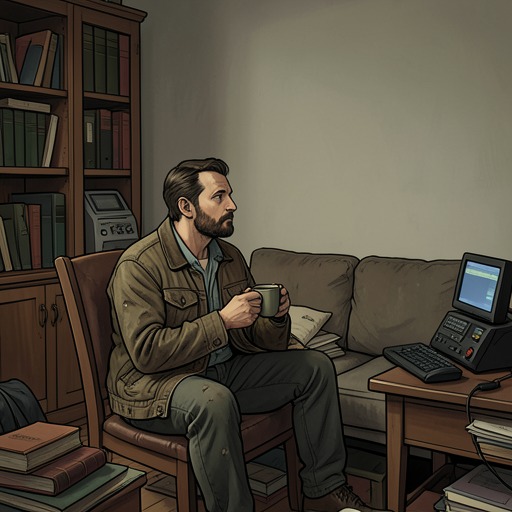
Auden confides in Eli after overhearing her father and Heidi argue
Along for the RideAuden confides in Eli after overhearing her father and Heidi argue during a late-night newspaper route, a scene that turns a family quarrel into a confrontation with Auden’s own history. Hearing Robert admit that he was not ready for family life revives her childhood fear that she should have been able to keep her parents together; telling Eli this makes the old, unspoken blame newly explicit.
The route to Robert’s house
The episode unfolds while Auden and Eli are delivering newspapers in the early hours of the morning. As Eli turns, Auden recognizes her father’s neighborhood and realizes that Robert’s house is approaching on her side of the car. She reads the coincidence as a sign and takes a paper from the stack, deciding to deliver this one herself.
Her attempt to throw it toward the porch goes wrong: the paper lands on the windshield of Heidi’s Prius. Eli stops so she can retrieve it, then Auden creeps up to the porch to place it on the center of the mat. The small misadventure gives the scene its particular threshold. Auden has approached the family home on an ordinary errand, but at nearly three in the morning the voices inside make it clear that something more serious is happening.
What Auden overhears
From outside, Auden hears Robert argue that he had wanted Heidi to have what she wanted, and ask what he himself wants. Heidi’s shaky question is whether he means that he does not want the baby. Robert says the argument is not about the baby; when Heidi presses him to explain, he says that he is older now but that this life is not what he expected, and that he was not ready for all of it. Heidi answers that this is his family, whether or not he feels ready.
The exchange leaves Auden uncertain about what Robert’s broad phrase includes. She takes it to mean, or fears it may mean, everything: the baby, Heidi, and the family itself. The scene does not disclose a final decision from Robert; instead, it exposes the strain between the life he has and his admission that he did not expect it. Heidi’s insistence that the family exists regardless of his readiness gives the argument a blunt consequence without resolving it.
Auden hears Robert begin to respond, but this time she does not stay to listen. She thinks of childhood hide-and-seek, in which the person hiding must remain still when the seeker comes near, then recognizes that she is no longer a child bound to the game. She can leave, and does. That choice contrasts with her remembered childhood vigilance: she once stayed awake trying to ward off what frightened her, whereas now she can walk away from the door and into the night.
The breakdown at Eli’s apartment
Auden initially believes she has managed the retreat. She crosses dew-damp grass to the truck and picks up another paper to throw. But when Eli asks whether she is okay, she starts crying. He does not press her to explain. He drives on, continuing the deliveries while she looks out the window and tries to stop sobbing. By the time they reach his dark driveway, she is calm enough to search for an excuse, considering whether to blame sudden-onset PMS or her poor paper-delivery skills.
Eli gets out and climbs the narrow stairs beside the garage without checking whether she follows. Auden does follow him into his plain apartment: one large room, a bed, a wooden chair, a television, and a tiny kitchen with a coffeemaker and filters. He turns on the coffee and begins preparing something at the stove, melting butter in a saucepan. The domestic simplicity gives Auden room to recover without requiring her to explain herself immediately.
When she starts to bring up what happened at the house, Eli tells her they do not have to talk about it. That offer briefly seems like an easy way to move on, but instead prompts Auden to answer a question Eli had asked earlier about what she had failed at. She names two failures: the social life she feels she missed, and keeping her parents together. The confession is not a conclusion she had consciously prepared; she realizes its truth as she says it.
The old fear made present
Auden connects the overheard argument to the dinners of her childhood: picky little disputes, a house that felt more unsettled as the hours passed, and the approach of her bedtime. She had learned to stretch the night around herself, staying awake and alert in an effort to hold her fears at bay. The strategy had not worked then, and hearing Robert and Heidi fight makes it feel as though it has failed again. Her tears break three years of stoicism, which makes the disclosure feel exposing as well as relieving.
Eli asks who was fighting. Auden tells him it was Robert and Heidi, that things have been rough since the baby arrived, and that the conflict seemed to erupt that night. Eli responds that fighting does not necessarily mean a couple is separating. He recalls that his own parents sometimes fought and that, for them, it could clear the air and leave things better afterward. His reassurance is grounded in his experience, but it cannot erase Auden’s knowledge of her father or her fear that she has seen this pattern before.
A disagreement about change
Eli’s assurance that people change meets Auden’s counterclaim that sometimes they do not. The exchange is the scene’s central tension: Eli offers the possibility that conflict can lead to improvement, while Auden measures the present against a family history that has taught her to expect repetition. Neither position settles what will happen between Robert and Heidi. Auden’s account instead reveals how their argument has activated the older belief that their relationship was hers to save.
The conversation also changes the meaning of her silence. At the house, Auden leaves rather than hear the rest of Robert’s words; at Eli’s, she finds language for what those words have brought back. Eli stays near without touching her or demanding an explanation, and his own face seems less haunted than before. The scene closes on their shared nighttime solitude: from above, the light in the small apartment would be only one among many, concealing the lives unfolding there and in neighboring houses. That image widens Auden’s private distress without diminishing it, placing her newly spoken fear among the many unseen struggles continuing through the night.